The landscape of higher education has undergone a seismic shift, moving away from the traditional “all-or-nothing” approach to a more fluid, integrated model. Today’s students are no longer confined to a physical lecture hall or a solitary laptop screen at home. Instead, they have become “Hybrid Students,” navigating a world where the boundary between digital and physical learning has blurred. This transition isn’t just about convenience; it’s about a fundamental change in how information is consumed, processed, and applied in a professional context. For the modern scholar, success depends on the ability to move seamlessly between these two environments while maintaining a high level of academic rigor and personal productivity.
Managing this dual-mode existence requires a sophisticated toolkit of digital resources and time-management strategies. As students juggle asynchronous lectures with in-person seminars, many find themselves searching for the most reliable assignment help websites to keep up with the increasing technical demands of their coursework; among these, myassignmenthelp has emerged as a key resource for those looking to bridge the gap between complex theory and practical application. By utilizing these professional networks, students can ensure that their written work meets the high standards required by modern universities while they focus on the networking and collaborative aspects of campus life. This strategic approach to learning is what defines the hybrid era: knowing when to engage deeply with peers and when to leverage external expertise to maintain a competitive edge.
The Rise of the Asynchronous Scholar
In the traditional model, learning was synchronous—everyone learned the same thing at the same time. The hybrid model flips this. Most theoretical work is now delivered via “asynchronous” methods, such as recorded modules or interactive digital textbooks. This gives students the freedom to learn at their own pace, pausing and re-watching complex segments until the concept clicks. However, this freedom comes with a heavy burden of self-discipline.
Without the physical “anchor” of a 9:00 AM lecture, students must become their own project managers. This involves mastering “Time-Blocking,” where specific hours are dedicated to deep work, and “Digital Minimalism,” the practice of removing distractions to ensure that the hours spent online are truly productive. The asynchronous scholar doesn’t just “go to school”; they manage a curriculum.
| Learning Phase | Traditional Synchronous | Modern Hybrid (Asynchronous) |
| Content Delivery | Physical Lectures / Fixed Times | Video Modules / On-Demand Access |
| Pace | Set by the Professor | Set by the Student’s Learning Speed |
| Interaction | In-class Q&A | Community Forums & Scheduled Seminars |
| Feedback | Delayed (Graded Papers) | Instant (Quizzes) & Expert Consultation |
Essential Tech for the Dual-Mode Classroom
To thrive, the hybrid student must treat their digital workspace with the same respect as a physical laboratory. This means moving beyond simple note-taking apps and embracing a full-stack digital infrastructure. Cloud-based collaboration tools have become the new “student union,” where group projects are managed across different time zones and schedules.
Tools that offer real-time editing and version control are essential. Furthermore, the integration of AI-driven research assistants helps students sift through thousands of peer-reviewed journals in seconds. The goal is to reduce the “cognitive load”—the amount of mental effort used in the working memory—so that the student can focus on higher-order thinking and critical analysis.
The Professional Student Persona
One of the most significant benefits of hybrid learning is how closely it mirrors the modern professional world. Most global businesses now operate on a hybrid or remote model, requiring employees to be tech-savvy, self-motivated, and excellent written communicators. Students who master the hybrid model during their university years are effectively “skill-stacking.”
They are not just learning history or engineering; they are learning how to manage remote projects, how to communicate professionally in virtual environments, and how to maintain high-quality output without constant supervision. This “Professional Student Persona” is highly attractive to employers, as it proves the student can handle the complexities of a modern, digitized workplace.
In this high-pressure environment, students often face specialized challenges in technical subjects that require both theoretical knowledge and practical data analysis. For those pursuing a career in corporate leadership, seeking business management assignment help is a common way to ensure that their case studies and financial reports reflect current industry standards.
Strategic Delegation: The Executive Student Mindset
In the business world, successful leaders know how to delegate. They focus on their core strengths and outsource routine or highly specialized tasks to experts. The hybrid student is starting to adopt this executive mindset. When faced with a 5,000-word dissertation or a complex literature review, many students realize that their time is better spent on networking, internships, or mastering a high-income skill.
Professional research support isn’t about avoiding work; it’s about optimizing results. By partnering with specialized academic consultants, students can see how a high-distinction paper is structured, how data should be visualized, and how to cite sources with 100% accuracy. This allows students to maintain a high GPA while building the “real-world” portfolio that actually gets them hired.
The Workflow of a Hybrid Scholar (C.O.D.E. Framework)
To stay organized, many high-achieving students use a workflow map to manage their academic output. This prevents the feeling of being overwhelmed by multiple deadlines.
- Collect: Gather raw data from digital lectures and physical library resources.
- Organize: Categorize information into “Project Buckets” using cloud storage.
- Delegate: Identify complex technical requirements (like data modeling or thesis formatting) and seek expert guidance.
- Execute: Compile the final submission using professional standards of clarity and tone.
Overcoming the “Hybrid Gap”
Despite the benefits, hybrid learning has its pitfalls. The biggest challenge is the “Hybrid Gap”—the feeling of isolation that can come from spending too much time behind a screen. To overcome this, students must be intentional about their on-campus time. Campus should be for high-value interactions: labs, face-to-face debates, and networking with professors.
The hybrid student treats the campus like a “Co-working Space.” They don’t go there to sit in a corner and read; they go there to engage. This ensures that they get the “social capital” of a university education while enjoying the “digital efficiency” of online learning.
The Mental Health of the Hybrid Student
Digital burnout is real. The “always-on” nature of hybrid learning can make it feel like you never truly leave the classroom. Successful hybrid students set strict boundaries. They have a “digital sunset”—a time when all school-related notifications are turned off.
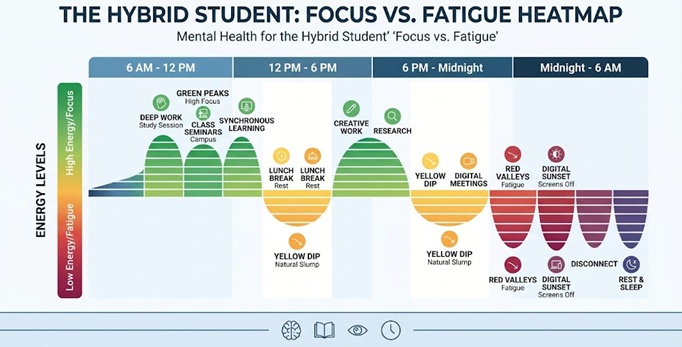
They also prioritize physical health, recognizing that a sharp mind requires a rested body. Strategies like the “Pomodoro Technique” or “Deep Work” sessions are vital for preventing the mental fatigue that comes from constant task-switching between different digital platforms.
Strategic Planning: The Semester Success Map
A hybrid student’s success is often determined before the semester even begins. Mapping out the “peaks” and “valleys” of the academic year allows for better resource allocation.
| Week Range | Academic Focus | Strategic Action |
| Weeks 1-4 | Foundation & Reading | Set up digital folders and research tools. |
| Weeks 5-8 | Mid-term Projects | Delegate formatting and initial research tasks. |
| Weeks 9-12 | Deep Research | Focus on primary data collection and analysis. |
| Final Weeks | Submission & Exams | Final review and professional proofreading. |
The Evolution of Academic Integrity in 2026
As learning becomes more digital, the definition of “academic integrity” is evolving. It is no longer just about avoiding plagiarism; it is about “authorized collaboration.” Using professional services to understand a complex topic or to get a template for a difficult report is increasingly seen as a form of tutoring. In the business world, using a consultant is a sign of intelligence, not a lack of it. The same is becoming true for the modern student who uses research support to master their subject matter.
Conclusion: The Future Belongs to the Integrated Learner
The hybrid model is not a temporary fix; it is the permanent future of education. As we move further into 2026 and beyond, the most successful individuals will be those who can integrate the best of both worlds. They will use digital tools to maximize efficiency and human expert networks to ensure quality, all while maintaining the interpersonal skills that can only be forged in a physical environment.
By viewing your education as a professional project—complete with deadlines, resource management, and strategic delegation—you are not just preparing for an exam; you are preparing for a career. The hybrid student is the prototype for the future global professional: adaptable, tech-literate, and relentlessly focused on high-quality outcomes. This balanced approach ensures that students do not just survive their university years, but thrive in them, emerging as well-rounded professionals ready for a hybrid workforce.
Frequently Asked Questions
What exactly is hybrid learning?
Hybrid learning is an educational model that integrates traditional face-to-face classroom instruction with online, digital components. This approach allows for a flexible schedule where students attend some sessions in person for hands-on collaboration while completing theoretical modules asynchronously at their own pace.
How does a hybrid model improve career readiness?
By balancing physical and digital environments, students develop essential professional skills such as remote project management, digital literacy, and self-discipline. This structure closely mirrors the modern global workforce, making graduates more adaptable to contemporary office and remote work settings.
What are the biggest challenges of dual-mode education?
The primary obstacles include maintaining a consistent study schedule without daily physical oversight and avoiding digital fatigue. Success requires strong time-management habits, such as setting strict boundaries for screen time and intentionally using campus hours for high-value networking and active engagement.
Is specialized research support considered helpful in this model?
Yes. In a high-pressure hybrid environment, utilizing professional research and documentation support is a form of strategic delegation. It allows students to focus on mastering core concepts and building their professional portfolios while ensuring their academic output meets rigorous institutional standards.
About The Author
Min Seow is a dedicated content strategist and academic consultant specializing in helping students navigate the complexities of modern higher education. With an emphasis on clarity and research-driven storytelling, Min provides expert insights on behalf of myassignmenthelp to empower the next generation of global professionals.